

HPHT · BIOLOGICAL CARBON · CRYSTAL GROWTH
The science behind something deeply personal.
A diamond begins with carbon. Through biological carbon preparation and high-pressure, high-temperature (HPHT) crystal synthesis, that carbon becomes part of a diamond’s crystalline structure. Explore the material science behind each of the seven production stages.
High-pressure, high-temperature diamond synthesis
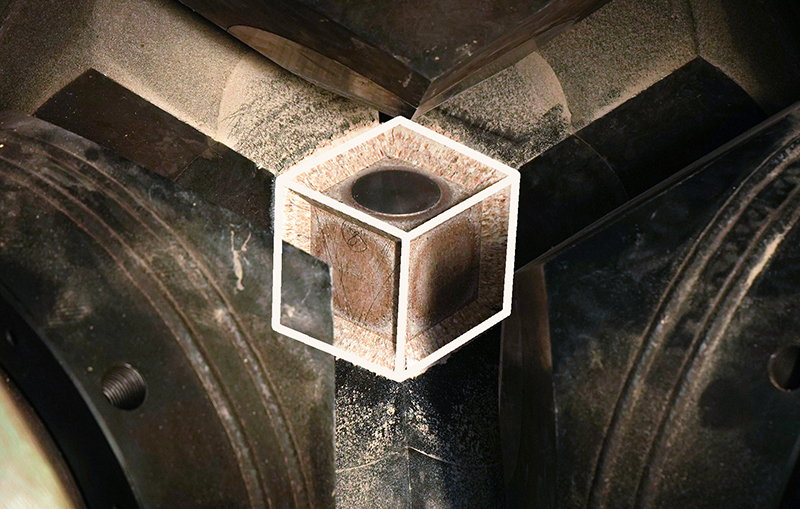
Graphite and diamond are allotropes of carbon: the same element arranged in different crystal structures. HPHT synthesis establishes the pressure and temperature conditions in which diamond can grow, using a metallic solvent and a seed crystal to control crystallisation. The resulting laboratory-grown diamond has the essential chemical composition and crystal structure of natural diamond.
The personal connection begins upstream of crystal growth, with carbon recovered from human hair or pet fur. Material preparation, carbon purity and growth conditions each have a distinct role in the synthesis process.
- Carbon purity
- ≥99.95%
- Synthesis pressure
- 5.0–6.0 GPa
- Growth temperature
- 1,350–1,600°C
Process reference values reported by BioGem Lab, rather than specifications for an individual order. Material assessment determines the production plan.
- 1
Biological material intake
Hair and fur contain keratin, a carbon-bearing protein. Sample assessment establishes whether the submitted material can provide a suitable carbon feedstock.
- Chain of custody
- Sample identification and handling records.
- Carbon yield
- Assessment of recoverable carbon before processing.
- 2
Carbon extraction
Controlled thermal and chemical decomposition separates the carbon fraction from the biological material. Extraction prepares a feedstock for subsequent purification.
- Thermal decomposition
- Breakdown of the organic material.
- Acid digestion
- Removal of mineral contaminants.
- 3
Carbon purification
Residual non-carbon constituents are reduced before synthesis. BioGem Lab reports a carbon purity of at least 99.95% for its purified feedstock.
- Filtration and washing
- Separation of residual contaminants.
- Inert-atmosphere treatment
- Purification with limited oxygen exposure.
- Spectroscopic verification
- Analysis of the prepared carbon.
- 4
Graphitization
Graphitization reorganises amorphous carbon into crystalline graphite, the feedstock used in this HPHT process.
- Hexagonal graphite lattice
- An ordered, layered carbon structure.
- X-ray diffraction (XRD)
- Verification of the graphite phase.
- 5
HPHT crystal growth
Within the pressurised growth cell, the graphite source occupies a hotter region than the diamond seed. Carbon dissolves in the molten metallic solvent and moves towards the cooler seed. Supersaturation allows it to crystallise as diamond, extending the seed’s lattice through sustained growth.
- Thermal gradient
- The temperature difference between carbon source and seed drives carbon transport.
- Solvent / catalyst alloy
- Iron, nickel and cobalt are commonly used in HPHT growth alloys. The molten metal dissolves carbon and enables growth at more accessible conditions.
- Seeded crystallisation
- A diamond seed provides the crystalline template on which new diamond forms.
- 6
Diamond cutting and polishing
The as-grown crystal is a rough diamond. Finishing converts it into a faceted gemstone, with a cut plan that considers the rough’s dimensions, internal features and intended shape. Retained carat weight is balanced with the proportions needed for light performance.
- Rough assessment
- Microscopic examination informs the orientation and cut plan.
- Sawing and bruting
- Separation and shaping establish the basic outline and girdle.
- Faceting and polishing
- Facet geometry, symmetry and surface finish shape the diamond’s brilliance.
- 7
Gemological assessment and delivery
The finished stone is examined for its gemological characteristics and prepared for delivery. Quality assessment describes the diamond itself; material and production records describe the journey that brought it into being.
- 4C characteristics
- Carat weight, colour, clarity and cut describe key aspects of diamond quality.
- Production documentation
- The finished stone is associated with its order and production record.
THE TECHNOLOGY BEHIND THE PROCESS
BioGem Lab describes its biological carbon extraction and purification technology as protected by a national invention patent granted in 2012: ZL 201010565778.9.
THE LABORATORY
A closer look, coming soon.
Laboratory information and photographs will be shared here soon.